
To the untrained eye, our freshly grazed pastures can look messy. Uneven. Unfinished. In fact, to folks steeped in industrial agriculture, it might even look downright wasteful.
Cattle in our mob-grazing system only eat about a third of what’s in front of them. They trample another third flat into the dirt, and they leave the bottom third standing tall.
Why in the world would a grass-fed beef producer deliberately “waste” good forage?
To answer that, we have to revisit an evergreen principle that has guided our grazing management since our earliest days—one we first broke down way back in Pasture Posts #19 and demonstrated during heavy spring downpours in Pasture Posts #55. We call it the Rule of Thirds.
The 10-Year Compound Interest in Our Back Pastures
We’ve had this principle on our minds heavily over the past few weeks. Recently, we moved the herd through some of our back sections where the summer forage—mainly a thick, vigorous mix of Johnsongrass and crabgrass—had exploded following the late-summer rains. In many spots, the Johnsongrass stood an astonishing 8 to 9 feet tall.
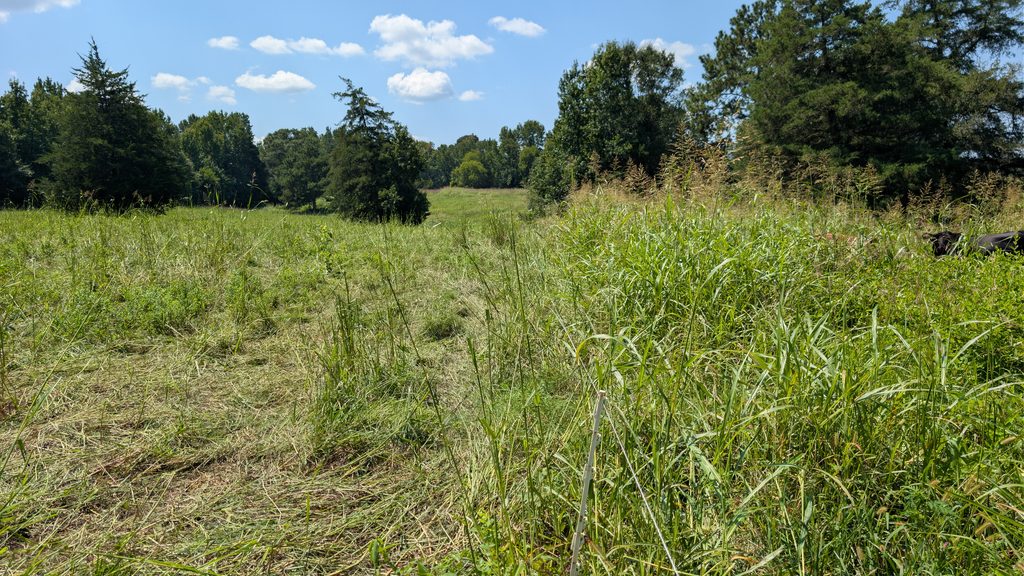
Before and after a daily move: Dense, 8-foot jungle on the right (spot the cows if you can!) and protected, insulated soil on the left. The power of rotational grazing in one single fence line.
When grass gets that high, the herd inevitably leaves more than a third standing, but the underlying principle remains identical. What’s most rewarding to see is why those back sections are flourishing with such incredible biomass in the first place.
About 12 years ago, we tackled a major infrastructure project back there: subdividing roughly 150 acres with cross fencing and laying dedicated underground water lines. That investment gave us the ability to step away from continuous grazing and build daily paddocks sized precisely to what the herd needs for 24 hours of grazing.
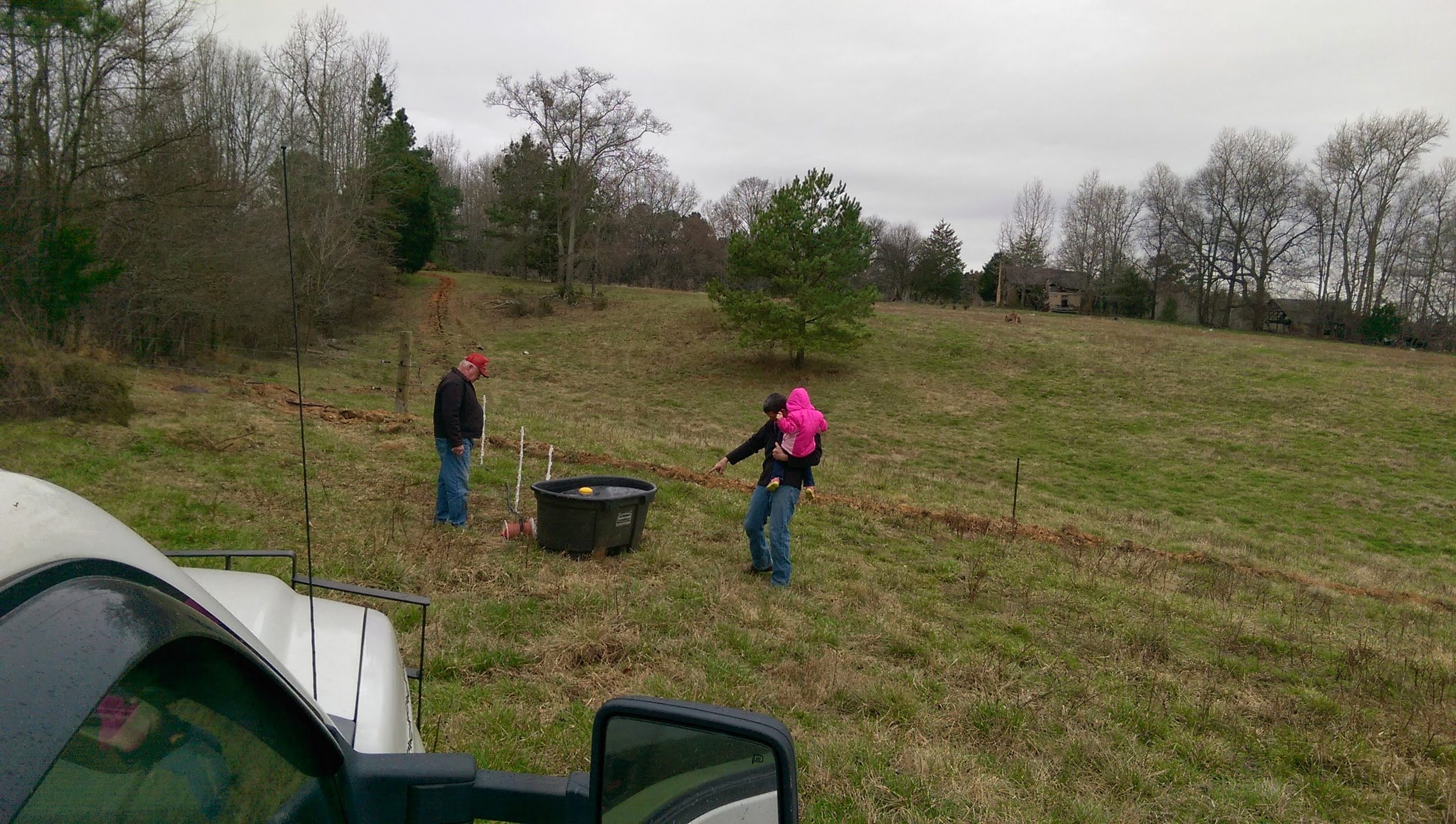
March 2015. New fences, brand-new pipe, and a lot of hope for what rotational grazing could do for this land. Dad (Gary) and I had just wrapped up six months of building cross fences and laying water lines through our back sections. Here I am trying to explain the ins and outs of a portable drinker tank to 2-year-old Abby. Looking back over a decade later, it’s incredible to see how that infrastructure laid the foundation for the resilient, living soil we have today.
We have not applied an ounce of synthetic fertilizer to those pastures. That towering growth is not the result of a chemical spray rig; it is the compounding interest of a decade of daily moves, high-density hoof impact, trampled forage, and long, generous rest periods.
What Actually Happens When You “Waste” Grass
When cattle trample forage into the earth and leave a third standing, nature goes to work:
- Soil Armor & Microbe Survival:
In the heat of a Carolina late summer, bare exposed red dirt can easily spike past 130°F. At those temperatures, soil moisture evaporates in minutes and beneficial soil biology (mycorrhizal fungi, earthworms, beneficial microbes) literally cooks and dies. The trampled grass creates a thick “thatch” layer—a living blanket that insulates the ground, keeping soil temperatures 20 to 30 degrees cooler while trapping vital moisture. - Water Infiltration Over Erosion:
When heavy thunderstorms hammer Chester County, bare or overgrazed soil can’t absorb the volume fast enough. Rain hits like a hammer, slicking off topsoil and sending red clay straight into local creeks. Trampled thatch acts like a giant sponge. Raindrops strike the plant armor rather than bare dirt, soaking inches of water straight down into our subsoil and recharging the water table. - The Solar Panel Left Behind:
When pasture is grazed down to the roots, the plant undergoes severe shock. To put on new leaves, it has to cannibalize energy stored deep in its root reserves. By leaving the bottom third of the plant standing, the grass retains its natural “solar panel.” Photosynthesis continues uninterrupted, fueling rapid regrowth naturally without synthetic nitrogen fertilizers. - The Flavor & Nutrition Connection:
Because the plants are never shocked into survival mode, they develop deep, expansive root networks reaching several feet into the subsoil. Those deep roots draw up trace minerals and nutrients that shallow root systems simply miss. That biological diversity translates directly into what arrives on your plate: rich, complex beef flavor, clean healthy fat, and elevated levels of CLA and heart-healthy Omega-3s.
What looks like “waste” on the surface is actually an investment in our soil’s savings account—and your family’s dinner table.
Product Spotlight: 10% Off 100% Grass-Fed NY Strip Steaks!
To celebrate what all that healthy, living soil creates, we’re putting one of our premier steak cuts on special this week.
Right now, take 10% off our 100% Grass-Fed & Grass-Finished NY Strip Steaks!
- Why You’ll Love Them: Cut from the short loin, the New York Strip delivers the perfect balance of robust, beefy flavor and tender texture. Finished strictly on diverse forage with no grain, no antibiotics, and no added hormones, our strips feature a clean, golden-hued fat cap that renders beautifully when seared hot in a cast-iron skillet or over an open flame.
- Cooking Tip: Keep it simple—coarse salt, freshly cracked pepper, a quick high-heat sear on both sides, and let it rest for 5–7 minutes before slicing.
(Discount is already marked down on the website—no coupon code required at checkout.)
👉 Shop the NY Strip Steak Sale (10% Off)
(Sale runs while supplies last through this week!)
Thank you for partnering with us to heal the land, support regenerative family farming, and feed your family real, honest food.
— Matt Watson & the Watson Farms Family
Check out this ⭐⭐⭐⭐⭐ review from Leigh Ann:
“Customer service is awesome! Their meat is fantastic! I love how they care for their animals and the land!”
We would greatly appreciate it if you would be kind enough to leave us a review. It helps first-time customers purchase with confidence.
Shipping Timeline and Store Hours
Orders for Shipping
(all orders ship with insulation and dry ice)
Free Shipping over $199!
Orders normally ship out on Mondays – Wednesdays.
Tracking: As usual, you will receive an automated email with a tracking link as soon as your label is created.
Farm Pickup (Always Free!):
If you are local, Farm Pickup is often the fastest way to get your products. Please wait until you receive an email stating that your order is Ready for Pickup (typically 1 business day after your order is placed) before heading over.
Farm Store & Pickup Hours:
- Monday, Tuesday, Thursday, Friday: 10:00am – 6:00pm
- Saturday: 10:00am – 2:00pm
- Wednesday & Sunday: Closed
Farm Store Address: 713 Colony Road, Chester, SC 29706